Watching your Child Struggling with Reading can be difficult for any parent. You may notice them avoiding books, taking a long time to read a simple sentence, guessing unfamiliar words, losing their place on the page, or becoming frustrated as soon as reading begins.
It is easy to wonder whether your child simply needs more practice. Sometimes they do. But sometimes the difficulty is connected to a particular reading skill that has not developed strongly enough yet.
While reading, a child needs to connect sounds with letters, decode words, build vocabulary, read with reasonable accuracy and fluency, and understand what the text means. When one or more of these areas are weak, reading can become overwhelming.s
The good news is that parents can make a meaningful difference. The aim is not to turn your home into another classroom. It is to give your child the right support, enough practice and, just as importantly, the confidence to keep trying.
Here are eight practical ways to support a child with reading difficulties.
1. Find Out Where Your Child Is Actually Struggling
Before trying to fix a reading problem, take a step back and observe what happens when your child reads.
Does your child struggle to recognize letter sounds? Do they know the sounds but find it difficult to blend them into words? Can they read individual words but lose the meaning of a paragraph? Perhaps they read accurately but very slowly, or they avoid reading altogether because it feels too difficult.
These are the different problems, and they should not all be treated in the same way.
Reading specialists commonly look at areas such as phonemic awareness, phonics, vocabulary, fluency, and comprehension when understanding reading difficulties.
For parents, this means one important thing: don’t start with random worksheets simply because your child is struggling. First, try to understand what is getting in the way.
Keep a small note of the mistakes you notice during reading. You may begin to see a pattern.
For example:
- Your child guesses words instead of sounding them out.
- They confuse similar-looking words repeatedly.
- They read each word correctly but cannot explain what they just read.
- They become exhausted after a few sentences.
- They avoid reading even when the book is at an appropriate level.
That information can be extremely useful when you speak with your child’s teacher or a literacy specialist.
2. Make Reading Practice Short, Regular, and Manageable
When a child is behind in reading, parents sometimes respond by increasing the amount of practice.
More practice is not always better.
If every reading session becomes a long battle, your child may begin to associate books with frustration. Instead, aim for short, focused practice that your child can handle successfully.
Choose a time when your child is reasonably alert. Keep the session predictable and stop before frustration takes over.
You can work on a small number of words, read a short passage together, or spend a few minutes talking about a story.
The goal is consistency rather than exhausting your child.
A struggling reader needs opportunities to experience success. Starting with material your child can manage and gradually increasing the challenge can help make reading feel achievable again. It is recommended to practice what a child already knows, keeping reading enjoyable and stopping when the child has had enough.
3. Read Aloud Even If Your Child Is Old Enough to Read Alone
One of the simplest things parents can do is continue reading to their child.
This does not become unnecessary just because your child is in primary school.
Reading aloud lets your child enjoy stories, hear natural expressions, learn new vocabulary, and discuss ideas without having to decode every word.
This is particularly valuable when independent reading is difficult.
You can choose a book that is slightly above your child’s own reading level and read a few pages together. Stop occasionally and ask simple questions:
“What do you think will happen next?”
“Why do you think the character did that?”
“What was the most interesting part?”
This keeps comprehension and language development moving forward while your child works on the mechanics of reading.
Reading aloud has also been recommended as a useful way to support children with dyslexia and other reading difficulties.
4. Work on Sounds and Phonics When Decoding Is the Problem
If your child struggles to sound out unfamiliar words, going back to the basics can be more helpful than simply asking them to read more books.
Phonics teaches children the relationship between letters and the sounds they represent. Phonemic awareness helps them notice and work with the individual sounds within spoken words. Both are important foundations for reading and spelling.
You can make sound practice part of ordinary conversation rather than turning every activity into a lesson.
For example, you might ask:
- “What sound do you hear at the beginning of sun?”
- “Can you say the sounds in cat?”
- “What happens if we change the /c/ in cat to /h/?”
- “Can you find another word that rhymes with light?”
If your child has significant decoding difficulties, however, avoid trying to invent a complete teaching program yourself. A literacy specialist can identify specific skills that need attention and provide structured intervention.
5. Choose Books That Are Interesting — and Not Too Difficult
A book should challenge your child a little, but it should not leave them struggling with almost every sentence.
If every page contains unfamiliar words, reading becomes an exercise in frustration rather than an opportunity to develop fluency and understanding.
Let your child have some say in what they read. Comics, fact books, stories about animals, sports books, graphic novels or books about a favourite hobby can all have a place.
And don’t be afraid of rereading.
Children often benefit from reading a familiar story more than once. Second or third reading can feel easier, allowing them to pay more attention to accuracy, expression and meaning. Repeated reading is also used as a way to support reading fluency.
Most importantly, don’t use your child’s reading level to decide whether a book is “good enough.” A book your child genuinely wants to read is often a much better starting point than a book chosen only because it looks academically appropriate.
6. Talk About What Your Child Reads
Reading comprehension is more than being able to pronounce the words on a page.
A child can read every sentence correctly and still struggle to explain what the passage means.
This is why conversation matters.
After reading, ask your child to tell you what happened in their own words. Talk about the characters, important details, unfamiliar words and the main idea.
Instead of turning the conversation into a test, keep it natural.
Try questions such as:
- “What was this part mainly about?”
- “Why did that happen?”
- “What do you think the character was feeling?”
- “What would you have done?”
- “What was one new thing you learned?”
For children who struggle with comprehension, breaking reading into shorter sections and discussing each section can make the information easier to process.
These conversations also help parents notice something important: whether the problem is actually decoding, comprehension, vocabulary, or a combination of several skills.
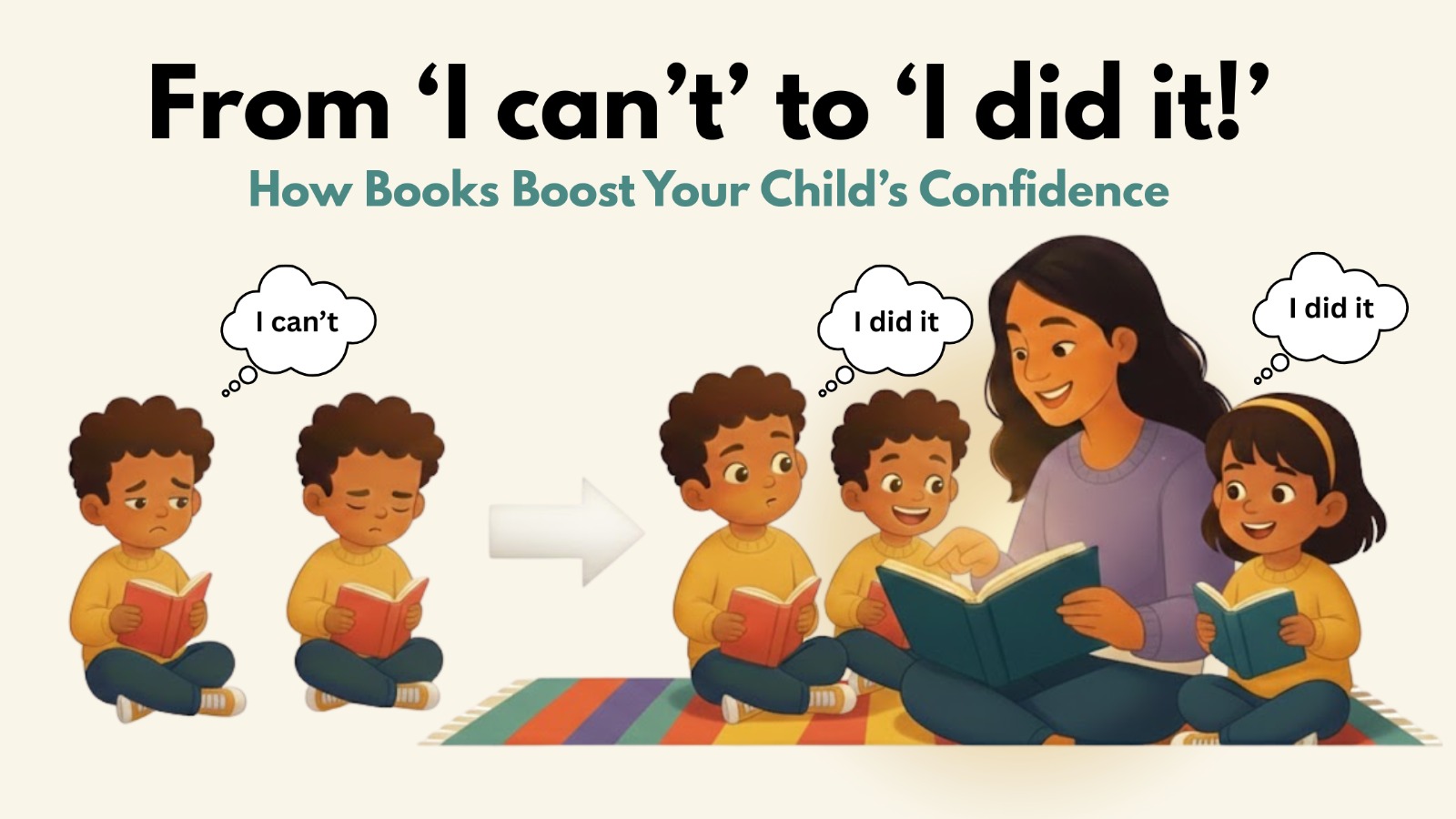
7. Protect Your Child’s Confidence
This may be one of the most important things a parent can do.
When children repeatedly struggle with something their classmates seem to find easy, they can start believing that they are simply “bad at reading.”
That belief can become a bigger obstacle than the original difficulty.
Try not to compare your child with siblings, classmates, or cousins. Avoid comments such as “You should know this by now” or “Why aren’t you reading like the other children?”
Instead, notice specific progress.
“You read that word by yourself.”
“You went back and corrected that sentence.”
“You remembered what happened in the last chapter.”
These small observations show your child that improvement is possible.
Research-based guidance for struggling readers also places considerable importance on recognising children’s strengths and celebrating progress rather than focusing only on mistakes.
Your child is more than their reading ability. Make sure they know that.
8. Know When to Ask for Professional Reading Support
Parents can do a great deal at home, but you do not have to solve every reading difficulty on your own.
If your child continues to struggle despite regular support, becomes increasingly anxious about reading, falls significantly behind classmates, or has persistent difficulties with decoding, fluency, spelling, or comprehension, it is worth discussing the situation with the school and seeking appropriate professional guidance.
Early support can be valuable, particularly when a child has an underlying reading difficulty. Professional assessment can help identify which skills need attention instead of relying on guesswork.
Looking for Personalized Reading Support for Your Child?
For parents who feel they have tried tuition, worksheets and repeated practice but still cannot understand why their child is struggling, personalized literacy support can offer a different starting point.
Supriya Raja, a Special Educator and Remedial Literacy Specialist, works with children who experience difficulties with reading, spelling, comprehension and writing. Her approach begins by identifying where the child’s literacy skills have broken down rather than simply giving every child the same reading exercises. Her 4-Pillar Power Reading Framework systematically addresses these gaps while helping children become more confident learners.
Her program includes remedial literacy support for children and resources that help parents build stronger reading habits at home.
If you are unsure why your child is struggling with reading or what kind of support they actually need, you can explore Supriya Raja’s reading support programmes and consider booking a clarity call to discuss your child’s needs.
Final Thoughts
Helping a child with reading difficulties is rarely about finding one magical exercise.
It is about understanding what the child is finding difficult, giving them appropriate practice, making room for stories and conversation, and protecting their confidence while they learn.
Some children need more time. Others need targeted support to strengthen a particular reading skill. The important thing is not to wait until frustration has become the child’s normal experience of reading.
Notice the difficulty. Talk to the school. Support reading at home. And when you need help, get the right guidance. Most importantly, let your child know that struggling with reading today does not decide what kind of reader they can become tomorrow.